Not Draining
Standing water blocks spin on most machines — check this first.
Learn more →The tub fills, the wash cycle runs, but the drum won't spin — or spins weakly. Nine times out of ten it's one of six components. Here's how each is diagnosed and what the fix costs.
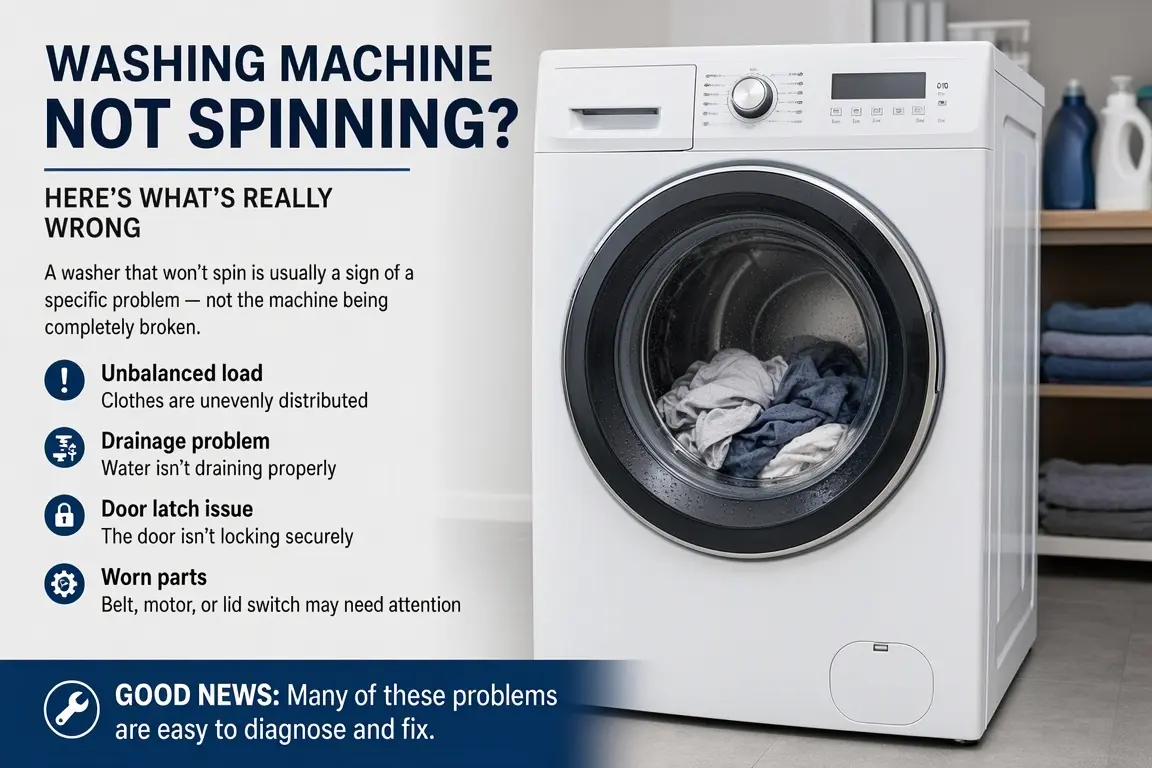
When a washing machine washes but won't spin, the motor gets blamed first — and is guilty least. The likeliest link also depends on the platform: front loaders fail at interlocks and pumps, top loaders at clutches and lid switches. The spin system is a chain: control board → door/lid switch → motor → belt or clutch → drum. The fault lives somewhere in that chain, and each link has a signature:
| Suspect | Signature Symptom | Fix Charge |
|---|---|---|
| Drive belt | Motor hums, drum turns freely by hand, rubber smell | Fixed quote |
| Lid / door switch | Nothing happens in spin at all; cycle stalls | Fixed quote |
| Capacitor | Motor hums but won't start (semi-auto & belt models) | Fixed quote |
| Clutch assembly (top load) | Spins empty, stalls with wet clothes | Fixed quote |
| Motor coupling | Motor runs, drum dead — common on direct-coupled units | Fixed quote |
| Control board / sensor | Random spin refusals, imbalance detection loops | Fixed quote |
Still not spinning? The chain needs a technician with a multimeter and load-testing experience — book a doorstep visit and we'll name the failed part before we quote. If the failure comes with a hot rubber smell at spin start, our burning-smell guide narrows the chain further.
The mechanical culprits get their own deep-dives: a worn-out drive belt or motor coupling, a tired drive motor, a failed lid switch or door lock, or a slipping clutch. For anything beyond parts, our professional washing machine service handles the full diagnosis at your home.
Standing water blocks spin on most machines — check this first.
Learn more →Grinding before total spin failure usually means bearings.
Learn more →Full price transparency before you commit to anything.
Learn more →Spin failures arrive in patterns, and the pattern usually names the component before a single panel is removed. Match what your machine actually does against the chains below, and the diagnosis narrows fast. Semi-automatic spin faults are a world of their own, covered on our semi-automatic repair page.
| What You See | What It Usually Means | Next Step |
|---|---|---|
| Hums, drum still, turns freely by hand | Snapped drive belt or sheared motor coupling | Belt/coupling replacement — same visit |
| Spins empty, stalls with clothes | Worn clutch or weak run capacitor | Clutch service or correctly rated capacitor |
| No reaction at the spin stage only | Lid switch / door interlock not engaging | Interlock test and replacement |
| Spin starts then aborts, drum shuffles | Imbalance detection — real load or worn suspension | Redistribute load; check shock absorbers |
| Intermittent — spins some days, not others | Worn carbon brushes losing contact | Brush replacement at the motor |
| Refuses spin while water remains | Blocked drain path keeping the pressure sensor high | Filter and drain path clear-out |
Confirm the guess with a proper doorstep diagnosis — book a visit and the failed link in the chain is named before anything is quoted. For the parts behind these chains, our motor and brush repair page covers the electrical end of it. When refusals arrive with thumping or walking, worn damping is the usual trigger — the mechanical side sits in our vibration and shaking guide.
Quick answers about our washing machine service, repair process, warranty and pricing.
Only the basics: check the machine is level, the load isn't unbalanced, and the drain filter is clean. Beyond that, live electrics and water mix dangerously inside a washer — belt, clutch and switch work belongs to a qualified technician.
The doorstep diagnosis is ₹400, fully adjusted into your repair bill. Once the failed part is identified, you receive a fixed quote for your exact model before any work starts.
The drive is too weak for a real load — classic worn clutch (top load) or slipping belt. It confirms the motor itself is fine, which keeps the repair affordable.
Power is reaching the motor but the drive is not turning the tub: a snapped drive belt, a sheared motor coupling, or on semi-automatics a seized spin tub. Unplug and turn the drum by hand — if it moves freely by hand but not by motor, a belt or coupling replacement is the prime suspect.
Yes — a weak run capacitor lets the motor hum and even spin an empty drum, then stall the moment wet clothes add load. Capacitors degrade with heat and age on every belt-drive and semi-automatic platform. The fix is inexpensive, but the rating must match the motor exactly — see capacitor replacement.
Imbalance protection stops or restarts the spin when the sensor sees a lopsided load, while a hardware fault prevents spin at any load. Retry with half the clothes spread evenly: if spin returns, the detection logic and suspension are doing their job; if not, the chain needs a proper spin-failure diagnosis.
On brushed universal motors, worn carbon brushes lose contact intermittently — the washer may spin some days and refuse on others, or spin only without load. That come-and-go pattern is the brush signature, and a motor repair with new brushes is a routine doorstep job.
Safe user checks end at power, load balance and the filter. A technician measures motor winding resistance, capacitor microfarads, lid-switch continuity and tachometer feedback with instruments, and load-tests the clutch — tests that mix live wiring with water should never be attempted at home. Book a doorstep diagnosis instead.
Slow spin means slipping drive between motor and drum — a glazed belt, worn clutch plates in a top load transmission, or a dragging bearing adding resistance. It almost always ends in complete spin failure within weeks, so an early clutch or belt service is the economical moment to act.
Yes, and it points away from the motor. On front loaders a failed door interlock or a stuck water-level pressure sensor halts the sequence before spin; on top loaders the lid switch does the same. The cycle logic refuses to spin until the safety input arrives — that is why we test the interlock first.
Faults travel together because their parts overlap — a drainage failure can dress itself up as a spin problem. These related guides, parts and services help you narrow the cause before booking.
Spin failure is a chain, not a part — lid switch, belt, capacitor, clutch and board each get tested in order. If the drum turns by hand but not on power, start with the lid-switch service; humming without motion points to the capacitor.
Call or WhatsApp — share your washer brand and the problem. We'll send a skilled repair expert to your doorstep.